
CELEBRITY
President Trump is trying to make it harder to vote. Here’s why that matters

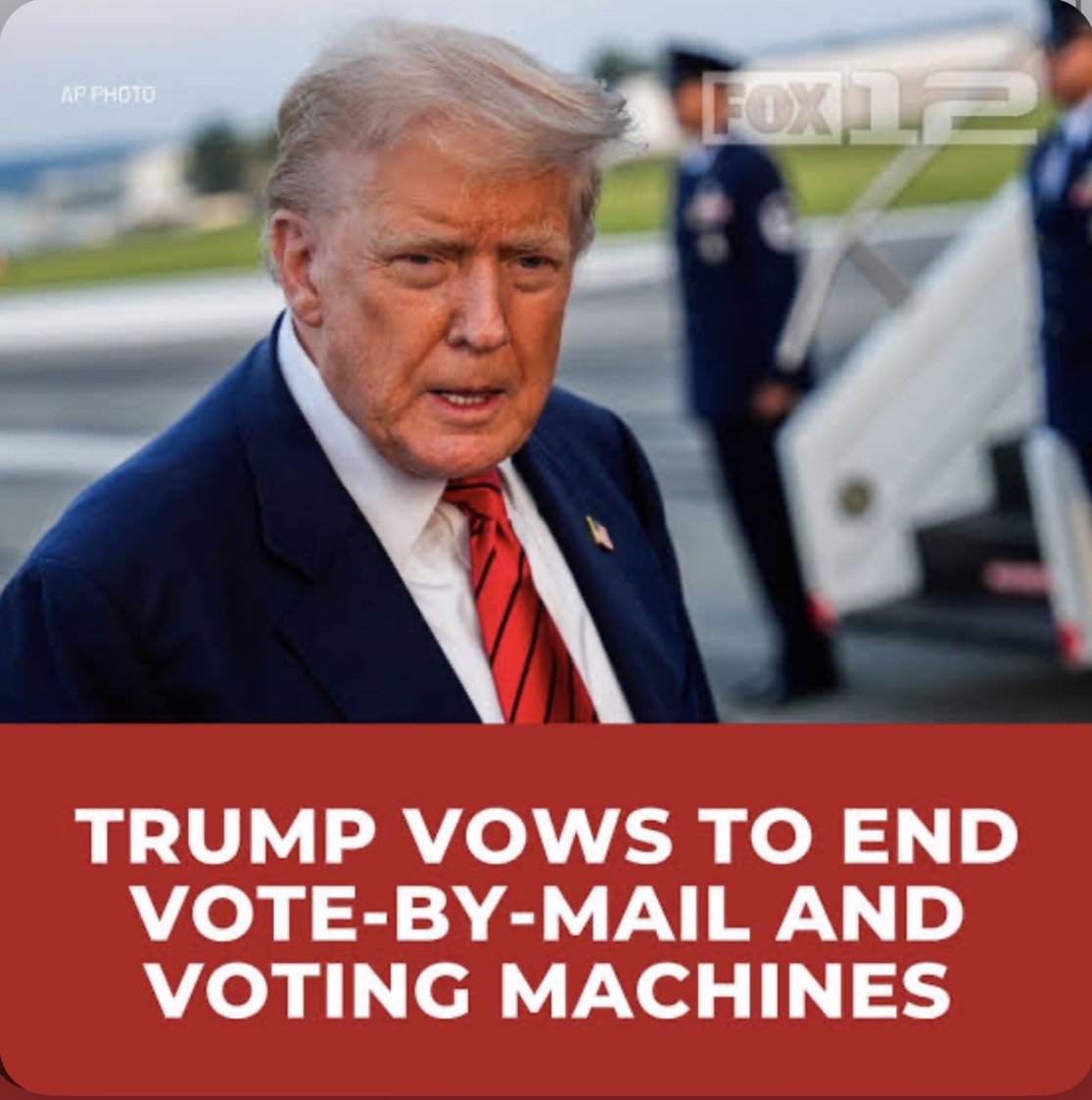
President Trump is trying to make it harder to vote. Here’s why that matters
Trump is promoting tighter restrictions on mail-in ballots as well as passage of the SAVE Act, which requires proof of citizenship to vote. UCLA professor Richard Hasen unpacks the ramifications.
This is FRESH AIR. I’m Terry Gross. Election season is underway, with primaries today in Texas, North Carolina and Arkansas. Meanwhile, President Trump is pushing Congress to pass legislation – the SAVE Act – that would change how every American citizen registers to vote and votes. Predictions are that millions of American citizens would be unable to fill the ID requirements. It would cause chaos at the polls, make it chaotic for counties and states overseeing elections and possibly make it challenging to decipher who really won. But Congress seems unwilling to pass that, so President Trump is threatening to issue an executive order that would do all that and more.
My guest, Rick Hasen, is an expert in election law. He founded the popular Election Law Blog. He’s a professor of law and political science and director of the Safeguarding Democracy Project at UCLA School of Law and the author of numerous books, including “A Real Right To Vote: How A Constitutional Amendment Can Safeguard American Democracy” and the forthcoming book, “Unbent Arc: The Rise And Decline Of American Democracy 1964-2024.”
Rick Hasen, welcome back to FRESH AIR. I want to start by expressing my condolences. I know your mother died in late February, about a week ago, and I’m very sorry.
RICK HASEN: Thank you.
GROSS: I’d like to talk with you about the executive order or orders that President Trump is threatening to sign. One of them – this story was broken by The Washington Post last week, and it has to do with a conspiracy theory. Would you describe the conspiracy theory?
HASEN: Well, there are a number of conspiracy theories and a kind of whole election denial complex that’s floating out there – people who believe that there was, or claim that they believe that there was interference in the 2020 election and the 2024 election by various foreign entities, including China and Iran. And the idea would be that Donald Trump would use his powers to protect the national security of the United States by imposing a number of various restrictions on how people register to vote, how people vote, and how states tabulate. That is how they count the votes.
GROSS: So can you be more specific about how this executive order, which we’ll explain in a minute, ties in with this conspiracy theory about foreign interference in 2020 and 2024, leaving out, by the way, Russia, which really did try to interfere and which did have bots and stuff that were interfering with reality, with truth?
HASEN: Right, so, you know, there’s different kinds of interference that have been alleged. You’re referring back to what happened in 2016, when the Russian government had a kind of influence operation to try to sway public opinion through various impersonation and false statements and things that were posted on social media. People debate how much of an effect that had, but that was trying to kind of hack the minds of the American people. It wasn’t actually hacking voting machines – some allegations that the Russians had probed some voter registration databases not to really do anything, but maybe just to show that they were trying to have some kind of interference, but there’s been no proof of any changes in votes, changes in voter registration databases or anything else.
Same thing in 2020. There were allegations that Russia and China and Iran tried to do influence operations, tried to get Americans to fight each other, get us to be more polarized, to influence who might be voted, to undermine people’s confidence in the integrity of the elections, but again, nothing that showed actual interference with voting machinery or tabulation. And yet these conspiracy theories claim that there’s something wrong with the voting machines.
This may be why Tulsi Gabbard, the director of national intelligence, was reported in Puerto Rico looking at voting machines back, I think it was, in January, why perhaps the FBI was seizing ballots and other records from Fulton County, Georgia, where Trump had claimed in the 2020 election that there was interference that led to Joe Biden’s victory in the state of Georgia. None of this is, of course, true, and it has been investigated. But it does seem to potentially serve as a background for pretextually claiming foreign interference as a basis for Trump to try to interfere with how elections are being run.
GROSS: So tell us more about what’s in this document that The Washington Post wrote about last week.
HASEN: So this document was a document not prepared by anyone in the administration, but prepared by a group of election deniers, people who have long claimed that there could be some kind of national security reason for messing with elections. And what this executive order that was drafted by these activists purports to do is to claim that this threat of foreign interference would give the president vast powers over elections to change everything from how people register to vote, what documents they would need to prove to register to vote, whether they could register to vote online. It would ban basically all means of registering to vote except those that would be in person or by mail, and it would require the production of documentary proof of citizenship.
And let me explain what that is because that’s different than voter ID. So voter ID – you go to the polls, maybe you’re going to take out your driver’s license or something like that. This is different. This is in order to register to vote, you would have to provide evidence that you’re a citizen of the United States, which basically consists of either a passport or your birth certificate or your naturalization certificate. If you’ve changed your name, for example, because you got married, you’d also have to provide evidence of your name change. These are not the kind of documents that people have easy access to. This would be a huge impediment to people voting. It would essentially require everyone to re-register to vote. It would change…
GROSS: So you’d have to start from scratch. Even if you voted for decades, you’d still have to prove your citizenship with those documents. And getting those documents sometimes requires, you know, writing to the city and, you know, asking for a copy of it.
HASEN: And paying for it, as well.
GROSS: And paying for it, right.
HASEN: Everything I’m telling you about this – what’s in this draft executive order that these activists have come up with is supposed to be implemented in time for the 2026 elections. So it’s really an impossible task if this is actually what gets produced. And I’m kind of skeptical that this document would be the executive order, but it does kind of give us a window into the thinking of these conspiracy theorists. So they change voter registration. They would change the requirements for identification at the polling places, imposing a national system for that. They would require states to match the voter registration with federal databases to try to figure out who’s a citizen. We don’t have a good database of who is an American citizen.
They would change the rules for how ballots had to be tabulated. They would change the timetable for the receipt of ballots by mail. They would eliminate most absentee balloting. And then they would require all lawsuits to be brought in federal court rather than in state courts. It would be, essentially, a federal takeover of elections, making registration and voting much more difficult on a time frame that would be impossible to do in time for the 2026 elections.

🔴Poniedziałkowe referendum konstytucyjne okazało się jedną z największych porażek w karierze premierki Włoch. Upadek flagowej reformy rządu może sugerować, że era gładkich sukcesów Giorgii Meloni powoli dobiega już końca.

Wpadł w najmniej spodziewanym miejscu! 🫢

Viktor Orban podkreśla konieczność zmiany relacji z Rosją, twierdząc, że bez tego Europa Środkowa nie odniesie sukcesu. Co to oznacza dla regionu?

Izrael nie zamierza czekać na decyzje USA i kontynuuje działania w Iranie. Jakie warunki postawił Teheranowi?

Skandale w ‘The Traitors’! 😱

😔 Wicemistrzyni kraju usłyszała diagnozę, która zmieniła wszystko. Nowotwór i przerwana kariera 🎗️🏃♀️ Jej słowa dają do myślenia 💬

✝️ Co w małżeństwie jest dozwolone, a co już nie? 🤔⛪ Granice według Kościoła mogą zaskoczyć. Co o tym myślisz? 📖

Horror 🥶

Jak Wam się podoba?

Agnieszka Kaczorowska zaskoczyła Marcina Rogacewicza wyjątkowym prezentem na jego 46. urodziny. Co kryje się za tajemniczym tortem?

“To nie jest dokument, który sporządzono na kolanie” – mówi o SAFE gen. Leon Komornicki.
